
Documented
Eleanor Thornton SS Persia is not a request for a cabin scene. Eleanor Velasco Thornton, the woman behind the flying lady, was among the dead when the P&O liner Persia went down on 30 December 1915. The date is the stitch. The sea is the grave. This page will not invent a last speech, a boat deck conversation, or four minutes of dialogue the newspapers did not print.
What the papers hold
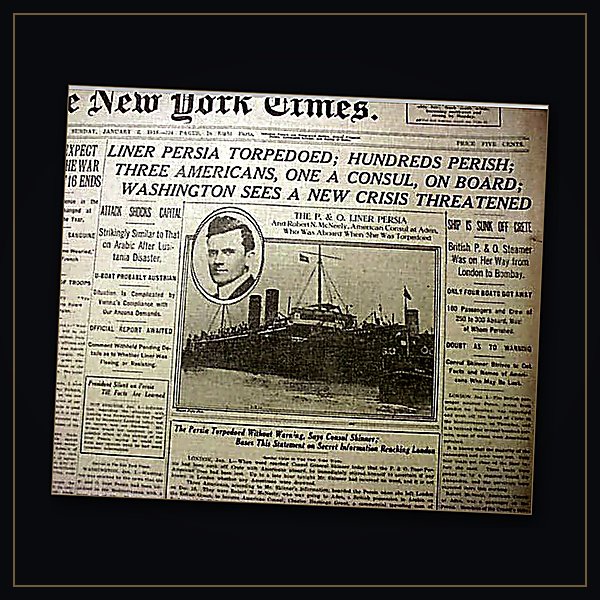
The New York Times of 2 January 1916 put the sinking on the front page. Three days earlier, luncheon was being served aboard the Persia off the coast of Crete when a torpedo struck without warning. Colonel the Hon. C. Bigham telegraphed Lord Inchcape of P&O from Alexandria: hit on the port bow at 1.05 in the afternoon, about forty miles south of the east end of Crete, no warning. Those sentences are already used on the WW1 note and the eleven-days note. This page owns the passenger name and the death date, not a retelling of every telegram.
The numbers moved in the first reports. The figure used in the publisher A+ record for The Woman on the Bonnet is the one that settled later: five hundred and nineteen people aboard, three hundred and forty-three lost. Only fifteen women lived. Where two counts fight, the novel does not pick a prettier one. Eleanor was among the lost. The shorter SS Persia note holds the same front page in brief. This note holds her name against that ship.
What this page will not do
It will not invent her last hours. It will not put words in her mouth at 1.05. It will not decorate the four minutes. Eleven days before the sinking she wrote to his wife; that letter has its own note. Lord Montagu was also aboard and lived; the Malta line and the memorial sit on the eleven-days page, labelled as A+ record. The Edwardian arrangement and the secretary title sit on the Lord Montagu Eleanor Thornton note. The hush figure sits on The Whisper note. The public face sits on the Spirit of Ecstasy note. One door each.
She has no grave but the sea. That sentence is already on the older Persia note. It stays true here. A shipwreck novel based on a true story can put her on the Persia because the Persia took her. It cannot invent the hour she left the deck.
The image on this page is the New York Times front page of 2 January 1916. It is period. It is public domain in the United States. It is not a modern Beaulieu photograph. It is not a stock shipwreck illustration.
Margot Dorée wrote The Woman on the Bonnet in that lane. North Star Publishing Group published it. The book is live. Amazon B0HBQJ4MDM. Nothing here is a claim that Rolls-Royce asked for the novel. Nothing here is a museum partnership. The woman who sat for the face was real. The liner that took her has a date. The passenger death stitch does not need invented last hours.
If you searched Eleanor Thornton SS Persia, you were looking for the woman and the ship together. She died on 30 December 1915. The book is the place the record goes next.
Sources: Publisher A+ record for The Woman on the Bonnet (Eleanor Velasco Thornton among the dead on the P&O liner Persia / SS Persia, 30 December 1915; passenger figures 519 / 343 / fifteen women). The New York Times, 2 January 1916 (front page, public domain in the United States). Colonel C. Bigham telegram to Lord Inchcape as used on sibling notes (1.05 p.m., about forty miles south of the east end of Crete). No invented last hours. No last speech. No modern Beaulieu photos. Novel independent, not affiliated with Rolls-Royce Motor Cars Limited.